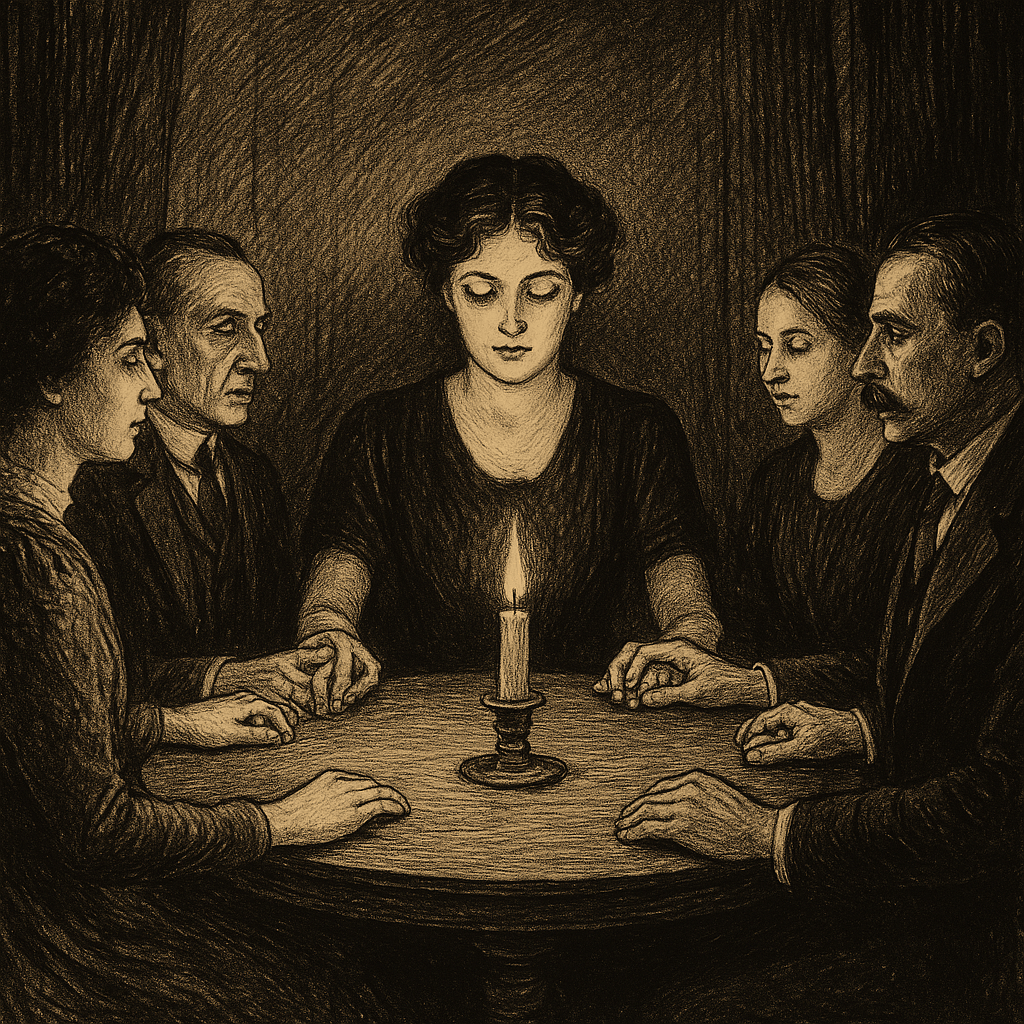
The parlor is quiet. The candles flicker. Someone whispers: Are you with us?”
In the hush of a candle-lit room, the living once believed they could reach across the veil. The séance was more than a superstition — it was a performance of grief, an act of longing dressed in ritual.
🕯️ The Birth of Spiritualism
In 1848, two sisters — Margaret and Kate Fox — claimed to speak with the dead through coded knocks in their Hydesville, New York farmhouse.
Neighbors came, reporters followed, and soon their story spread across America.
Thus began Spiritualism — a movement that promised direct communication with the departed.
At a time when disease and war stole loved ones without warning, the séance offered what no priest could: the sound of a familiar voice, the illusion of connection.
🔮 The Séance Becomes a Spectacle
By the 1850s, séances had evolved into performances.
Mediums like Daniel Dunglas Home could levitate tables and summon glowing apparitions. Eusapia Palladino performed before scientists and aristocrats.
Even royalty joined in — Queen Victoria reportedly held séances after the death of Prince Albert, and Sir Arthur Conan Doyle, creator of Sherlock Holmes, became one of Spiritualism’s loudest defenders.
The séance became a cultural fascination — half faith, half theater — where belief and deception danced by candlelight.
🪞 Houdini’s Crusade Against the Spirits
No figure looms larger in the downfall of séances than Harry Houdini.
After the death of his mother, Houdini sought comfort through mediums but found trickery instead. Outraged, he dedicated his life to exposing frauds who preyed on grief.
In 1926, he testified before Congress, urging laws against fake mediums. He arrived with trunks full of props — false hands, glow-in-the-dark paint, secret bells, retractable rods, and “spirit trumpets” that produced ghostly voices.
His demonstrations stunned lawmakers.
“The séance room,” he said, “is the magician’s stage dressed in mourning.”
(Library of Congress: Houdini Goes to Washington)
Yet, for all his exposés, belief endured. Even the Fox Sisters, whose confessions revealed their ghostly knocks were toe joints cracking beneath the table, couldn’t destroy the public’s fascination.
Faith — or perhaps the need for faith — was stronger than logic.
💀 The Faith That Wouldn’t Die
Houdini’s campaign ended with his death on Halloween night, 1926.
His widow, Bess Houdini, held annual séances on the anniversary of his passing for ten years, waiting for a signal that never came.
When she finally gave up, she said, “Ten years is long enough to wait for any man.”
Still, séances never truly disappeared. They went underground — smaller circles, quieter rooms, and now, digital screens.
You can find them on podcasts, livestreams, and ghost-hunting YouTube channels.
The need to reach beyond death, it seems, is eternal.
🌒 Why Séances Still Haunt Us
Perhaps séances were never really about ghosts.
Perhaps they were about the living — our refusal to accept silence, our desperate hope that someone, somewhere, still hears us.
We invent rituals because we cannot bear the quiet.
And so, even now, people light candles, form circles, and whisper into the dark:
“Are you with us?”
📚 Further Reading & Sources
- For Harry Houdini, Séances and Spiritualism Were Just an Illusion — Smithsonian Magazine
- Houdini’s Fight Against Spiritual Fraudsters — Medium
- Harry Houdini Goes to Washington — Library of Congress Blog
- The Psychology of Spiritualism — The Guardian
- A Magician Among the Spirits — Harry Houdini (1924)
- The Witch of Lime Street — David Jaher
- The Darkened Room — Alex Owen
✍️ About the Author
KL Adams writes about folklore, forgotten histories, and the thin line between the living and the lost.
Read more haunting history at The Ink Plot on Substack.
 Author KL Adams
Leave a comment